Walking vacation guide
Walking Vacations in Croatia: What a Week on Foot in Dalmatia Is Actually Like
Most people who find us are looking at a map of Croatia for the first time and trying to work out where the walking is.
The honest answer is that it isn't where most of the photos are. The islands are lovely and almost entirely flat. The walled towns are for wandering, not hiking. The walking in Croatia — the kind where you gain real height and finish the day with tired legs and a view you earned — happens on the mainland, in the limestone mountains that run along the coast a short drive inland from the water.
We're based in Omiš, 25 km south of Split, at the point where the Cetina river cuts through those mountains to the sea. We've been guiding here since 2003, and family-run as Malduk Adventures since 2014. This is what we tell people who email asking whether Croatia is worth a walking vacation.
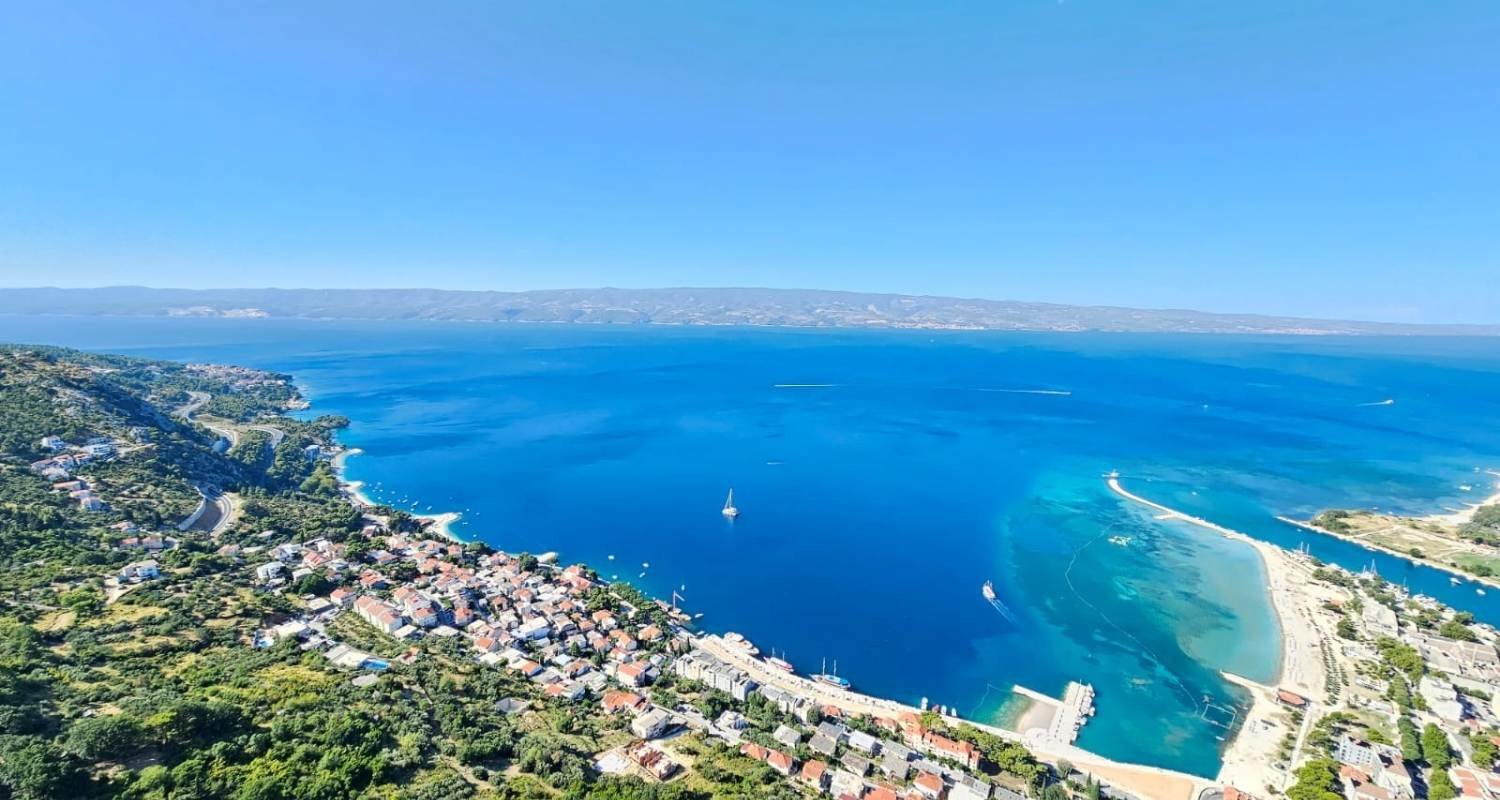
Where Dalmatia is, and why walkers end up here
Dalmatia is the long coastal strip of southern Croatia, from roughly Zadar down to Dubrovnik. Behind the beaches, the Dinaric Alps rise fast. In places you can stand on a trail at 1,000 m and look straight down at the Adriatic.
That proximity is the whole appeal. You are not choosing between coast and mountains. You walk up in the morning, you swim in the afternoon.
Getting here from the US
Split is the airport you want. There are no direct flights from North America, so you'll connect — most commonly through Frankfurt, Munich, Zurich, Amsterdam, London or Istanbul. Total travel time from the East Coast is usually 12 to 15 hours door to door.
From Split airport, Omiš is about 45 minutes by road. We offer pickup from Split, Trogir and Makarska, so you don't need to rent a car for a walking trip. If you're combining the walking with island time afterwards, the Split ferry terminal is the hub for everything.
Omiš as a base
This matters more than it sounds. On a lot of European walking vacations you move hotels every night, which means packing every morning and a luggage transfer you have to coordinate.
Our trips run from one base. You leave your suitcase in the room, you walk a different trail each day, you come back to the same shower. For a lot of people — especially anyone traveling solo, or anyone who has done a point-to-point trek and found the logistics wearing — that's the deciding factor.
When to come, and when not to
This is the part we're most direct about, because getting it wrong ruins the trip.
April to May, and late September to October
These are the walking seasons. Daytime temperatures sit in a range where climbing is comfortable, the light is long, and the coastal towns are awake but not crowded. Spring brings wildflowers across the Biokovo slopes and full, fast water in the Cetina. Fall brings warm sea — often warmer than in June — and the clearest air of the year.
If you can only come once, come in the first half of October. The sea is still swimmable, the trails are empty, and the rock has cooled.
Why July and August don't work for walking
Dalmatian limestone has almost no shade and it holds heat. On a bright August afternoon the rock radiates it back at you for hours after the sun has moved. Add high humidity off the sea and a midday climb stops being a pleasure and becomes something to get through.
We run river and sea days all summer, and those are genuinely good in the heat. But if walking is the point of your trip, come either side of it.
What the walking is actually like
Three different kinds of day, within an hour of each other.

Biokovo — the big coastal mountain
Biokovo is the wall you see from the coast road, and it's the serious walking in this region. Trails climb through holm oak and then out onto open karst — bare, pale, fissured limestone with long views down the Makarska Riviera. Underfoot it's rough and uneven. Ankle support helps.
Days here range from a steady 7 to 8 km with 500 m of ascent up to a long 20 km day. We'll match the route to what you actually want, and we'd rather talk that through honestly beforehand than watch someone struggle at hour five.
The Omiš hinterland and the Cetina canyon
Quieter and gentler. Old mule paths and shepherds' routes link villages that have been slowly emptying for a century. You walk past dry-stone walls, abandoned terraces, the occasional chapel. The Cetina canyon drops away on one side.
This is where you get the sense that you're walking through somewhere people lived and worked, rather than through scenery.
Plitvice and Krka — worth going, not hiking
Both are national parks, both are extraordinary, and neither is a hike. They're networks of boardwalks over turquoise water, flat and busy. Treat them as a day out, not a walking day, and go early. Our guided walking trip includes both for exactly that reason — they're too good to skip and too gentle to count as the trip.
Guided or self-guided?
Both work. They suit different people.
Guided means you walk with one of our guides, in a small group, with transport to each trailhead included. You don't navigate, you don't plan, and you get the local layer — which village was abandoned when, what the plant is, where the water is safe to drink. It's also the better choice if you'd rather not walk alone and don't have a walking partner.
Self-guided means we hand you the routes, the maps, the accommodation and the logistics, and you walk at your own pace on your own schedule. You stop where you like. You take as long as you like over lunch. Nobody is waiting at the top.
The question we'd ask is simple: do you enjoy navigating, or does it take the pleasure out of the day? Both answers are respectable.
What a walking vacation in Croatia costs
A week based in Omiš, with accommodation, guiding, trailhead transport and breakfast, is priced well below the equivalent week in the Alps or the Dolomites — which is a large part of why walkers are starting to come here. Self-guided costs meaningfully less than guided.
Current rates for each trip are on the trip pages: the 6-day guided walking holiday and the 5-day self-guided itinerary. We also break down where the money goes in what a Croatia adventure holiday costs. All four trips are compared on our walking holidays in Croatia page.
What's included, and what isn't
Included: accommodation, breakfast daily, guiding on guided trips, transport to and from trailheads, route notes and maps.
Not included: flights, lunches and dinners unless stated, drinks, travel insurance. We don't provide snacks or food on tour days, so bring what you want to eat on the trail.
For the walking trips, booking works like this: 10% deposit to reserve, balance due 15 days before arrival, free cancellation up to 14 days before.
How Croatia compares to the Alps, the Camino and the Dolomites
Versus the Alps or Dolomites: lower altitude, so no acclimatization and no snow worries in shoulder season. Less dramatic rock architecture. Much warmer, and you can swim at the end of the day. Significantly cheaper. Fewer people.
Versus the Camino: completely different proposition. The Camino is a long linear walk with a destination and a culture of its own. Dalmatia is a base, day walks, and the sea. If you want the pilgrimage, go to Spain.
Versus Greek island hiking: closer in character than anything else, but Dalmatia has real vertical gain. Biokovo is a mountain, not a headland.
The short version: come here if you want mountain walking and swimming in the same day, at a price that doesn't make you wince, somewhere that isn't yet busy.
What to pack for Dalmatian limestone
- Boots or trail shoes with real grip and some ankle support. The rock is sharp and loose in places.
- Two liters of water capacity minimum. Springs are unreliable in fall.
- Sun hat and high-factor sunscreen, even in October. There is very little shade.
- Light long sleeves. Easier than reapplying sunscreen all day.
- Trekking poles if you normally use them. The descents are rocky.
- Swimwear and a quick-dry towel in your daypack, every single day. You'll want them.
Frequently asked questions
Is Croatia good for a walking vacation?
Yes, if you come in spring or fall and head for the mainland mountains rather than the islands. Biokovo and the Omiš hinterland give you proper walking with sea views and a swim at the end of the day.
How many days do I need?
Five to seven. Five gives you three good walking days with arrival and departure around them. Seven lets you add a national park day and a rest day without feeling rushed.
Do I need to speak Croatian?
No. English is widely spoken in Split and along the coast, and our guides speak it fluently. A "dobar dan" on the trail is appreciated but not required.
Is it safe to walk alone?
The trails are safe in the ordinary sense — crime is not a concern here. The real risks are heat, dehydration and loose rock, and they're all manageable with planning. Cell coverage is patchy in the canyon and on the high karst, so tell someone your route.
How hot is too hot?
If the forecast is above the high 20s Celsius, start at first light and be off the open rock by midday. Above the mid 30s, swap the walk for a river or sea day.
Boots or trail shoes?
Either, as long as the grip is good and the sole is stiff enough for sharp limestone. Running shoes are not enough on Biokovo.
Can I combine walking with the islands?
Easily, and most people do. Walk from Omiš first, then take a ferry from Split to Brač, Hvar or Vis for a few flat, slow days afterwards. It's a good order — effort first, lounging second.
Walk Dalmatia with people who live here
We're a licensed Croatian tour operator, family-run in Omiš, and we've guided more than 2,000 guests with over 200 five-star Google reviews behind us. We know which trail holds shade until ten, which village has the one open café, and which descent to avoid after rain.
If you're weighing up a walking vacation in Croatia and want a straight answer about whether our trips fit what you're after, see all our Croatia hiking tours or just send us a message. We'll tell you if it isn't a good match.